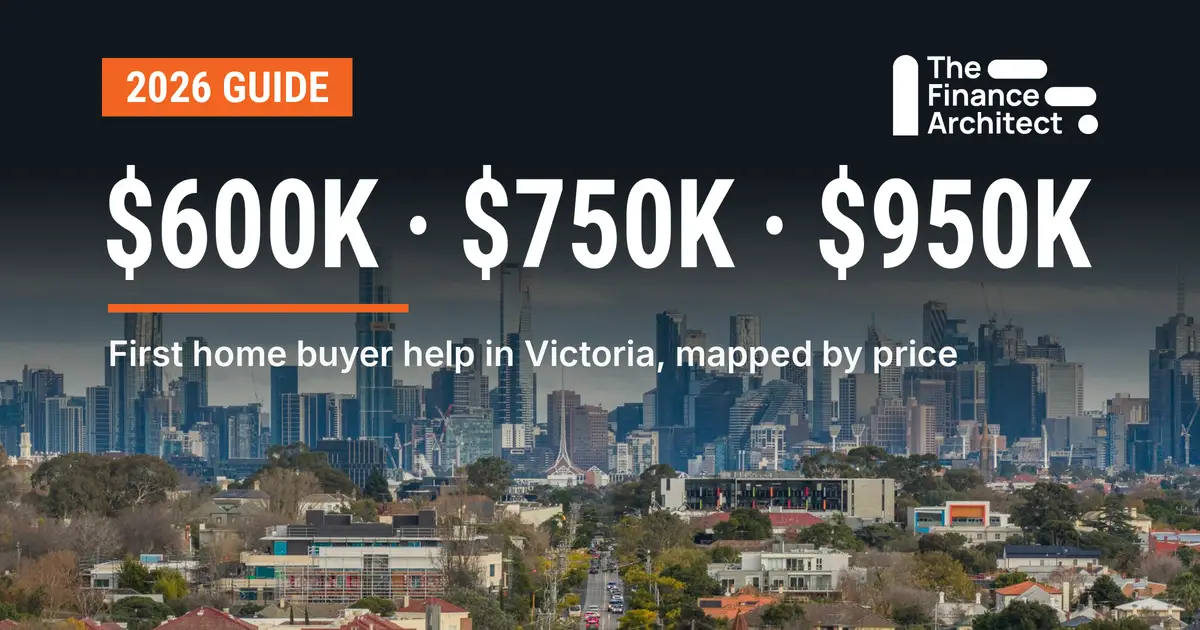
If you’re a first home buyer in Victoria, the help you can get changes at three price points: $600,000, $750,000 and $950,000. Most guides list the schemes one by one and leave you to work out which apply. This one starts with your price.
It’s also current. Since September 2025, the federal 5% deposit scheme dropped its income limits, Help to Buy launched, and the Victorian Homebuyer Fund closed. Plenty of pages that still rank haven’t caught up, and some still quote a grant that no longer exists.
Key points
- Up to $600,000: no stamp duty for eligible first home buyers, on new or established homes.
- $600,001 to $750,000: reduced stamp duty. The saving shrinks to nothing by $750,000.
- New homes up to $750,000: a $10,000 First Home Owner Grant on top.
- Up to $950,000 in Melbourne and Geelong: buy with a 5% deposit and no Lenders Mortgage Insurance (LMI) through the 5% Deposit Scheme, or with 2% through Help to Buy if your income qualifies.
- Schemes cut the deposit and the duty, not every cost. Budget for registration fees, legals and inspections too.
First home buyer help in Victoria at a glance (2026)
Seven programs are open to Victorian first home buyers in 2026. Three are run by the State Revenue Office, two by the federal agency Housing Australia, one by the ATO and one by Homes Victoria.
| Scheme | Run by | What you get | Price limit | New or established |
|---|---|---|---|---|
| First home buyer stamp duty exemption/concession | State Revenue Office (SRO) | No duty to $600k; reduced duty to $750k | $750,000 | Both |
| First Home Owner Grant (FHOG) | SRO | $10,000 | $750,000 | New only |
| 5% Deposit Scheme | Housing Australia | 5% deposit, no LMI | $950,000 Melbourne & Geelong; $650,000 rest of Vic | Both |
| Help to Buy | Housing Australia | Government co-buys up to 40% (new) or 30% (existing); 2% deposit | $950,000 Melbourne & Geelong; $650,000 rest of Vic | Both |
| First Home Super Saver (FHSS) | ATO | Save a deposit inside super | No price limit | Both |
| Off-the-plan duty concession | SRO | Reduced duty on off-the-plan purchases | No limit (temporary concession) | Off-the-plan |
| First Peoples Home Ownership Program | Homes Victoria | Grants towards deposit, duty and purchase costs | Program rules apply | Both |
Here’s how they line up against the price you’re likely to pay.
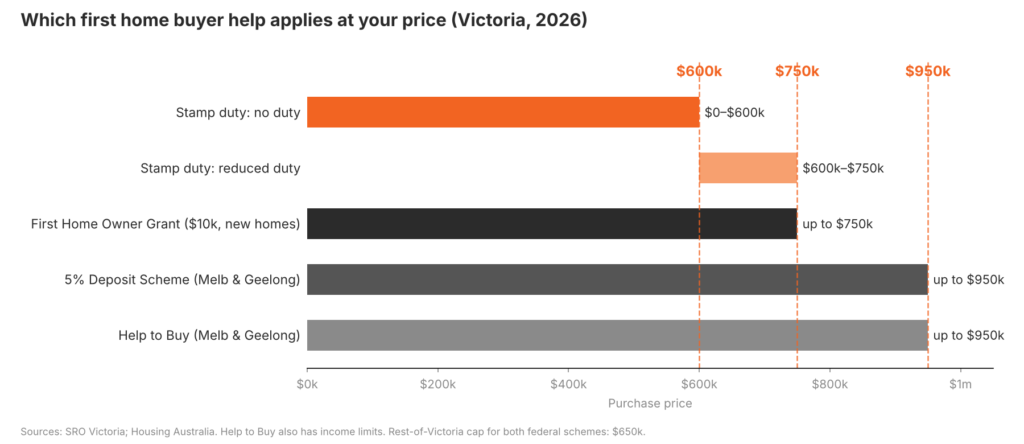
For context, Cotality’s Home Value Index put Melbourne’s median unit value at $620,996 and median house value at $906,067 at 31 October 2026. Dwelling values in Melbourne fell 7.6% over the year (Cotality, November 2026). A typical unit sits inside the stamp duty concession band. A typical house is past it, but still within the 5% Deposit Scheme cap.
Stamp duty: the biggest saving for most buyers
Stamp duty relief is worth more to most first home buyers than any grant. Eligible buyers pay no duty on a home valued up to $600,000, and reduced duty between $600,001 and $750,000 (SRO Victoria). Above $750,000, full duty applies.
Unlike the grant, it applies to new and established homes, and to vacant land you’re buying to build your first home on. So almost every first home buyer under $750,000 benefits.
What it’s worth at $650,000. On a $650,000 established home, a first home buyer pays $11,356 in duty. A buyer who isn’t a first home buyer pays $34,070. That’s a saving of $22,714.
Calculated with the SRO land transfer duty calculator on 31 October 2026: contract date 31/10/2026, residential, established home, principal place of residence, first home.
Watch the $750,000 cliff. The concession shrinks as the price rises and is gone by $750,000. At that price, a first home buyer pays full duty of $40,070 (same calculator and settings, new home). So near the top of the band, a small difference in price can mean thousands of dollars in duty. This assumes the full contract price is dutiable; buying off the plan can lower it (see below).
To qualify:
- All buyers must be at least 18, and at least one must be an Australian citizen, New Zealand citizen or permanent resident.
- Neither you nor your spouse or partner can have already received a first home grant or duty concession, or have owned and lived in a home in Australia for a continuous six months or more. Owning any home before 1 July 2000 also rules you out.
- At least one buyer must move in within 12 months of settlement and live there for 12 continuous months.
Your conveyancer usually claims the exemption or concession for you as part of the transfer.
Owned a home before? There’s a separate concession for owner-occupiers. But it only applies to homes valued up to $550,000 (SRO Victoria). So at $650,000, a buyer who isn’t a first home buyer pays the full $34,070, even if they’ll live there.
The $10,000 First Home Owner Grant (new homes only)
The First Home Owner Grant is a one-off $10,000 payment for buying or building a new home valued at up to $750,000 (SRO Victoria). “New” means never previously sold, lived in, leased or used for short-term stays.
That includes off-the-plan purchases (where the cap applies to the contract price), homes you build, substantially renovated homes, and homes built to replace a demolished one. Established homes don’t qualify.
At least one applicant must live in the home for 12 months, starting within 12 months of settlement or the build finishing.
Worth knowing: if you bought an investment property after 1 July 2000 but never lived in it, you may still be eligible.
The grant stacks with stamp duty relief, so a first home buyer building a new home under $600,000 can pay no duty and receive $10,000.
What’s changed: Some pages still quote a $20,000 grant for regional Victoria. That boost has ended. The grant is now $10,000 across Victoria (SRO Victoria).
If building is your path to the grant, it’s worth understanding how construction finance works before you sign a building contract. Our guide to building your first home covers progress payments and how they affect your loan.
The 5% Deposit Scheme (formerly the First Home Guarantee)
The 5% Deposit Scheme lets you buy with a 5% deposit and no Lenders Mortgage Insurance. The government guarantees part of the loan to your lender, which is what lets the lender waive LMI.
That matters because lenders normally charge LMI when you borrow more than 80% of the property’s value. On a $750,000 purchase with a 5% deposit, one broker’s example model estimates the premium at about $32,775 (Hunter Galloway, July 2026). Actual premiums vary by lender and loan size, but the scheme removes that cost entirely.
The scheme expanded on 1 October 2025 (Housing Australia):
- No income limits. Higher earners can now use it.
- No limit on places. All eligible first home buyers with a 5% deposit can apply.
- Higher price caps. In Victoria, the cap rose from $800,000 to $950,000 in Melbourne and Geelong. It’s $650,000 in the rest of the state.
You can only use the scheme through a participating lender, and not every lender on the panel offers the same rates or policies. That’s one reason the lender you choose matters for scheme loans. And if you’re still working out your savings target, see how much deposit you need for your first home.
Help to Buy: the 2% deposit shared-equity option
Help to Buy lets you buy with a 2% deposit while the government co-buys up to 40% of a new home or 30% of an existing one. Your loan is smaller, so your repayments are too. The scheme opened on 5 December 2025 and is run by Housing Australia.
Income limits apply. From 1 July 2026, your taxable income must be no more than $103,000 if you’re applying alone. For couples and single parents, the limit is $165,000 (Housing Australia).
In Victoria, the price cap is $950,000 in Melbourne and Geelong. Elsewhere it’s $650,000. You must be an Australian citizen aged 18 or over (Bank Australia, a participating lender). There are 10,000 places in 2026–27.
The trade-off is that the government owns part of your home. When you sell, it shares proportionally in any gain or loss. If you stop meeting the eligibility rules, you may be required to buy back some or all of its share.
Two rules to know:
- You can’t combine it with the 5% Deposit Scheme. Help to Buy is an alternative, not an add-on.
- You can still claim stamp duty relief and the FHOG if you’re eligible (Smart Property Investment).
Help to Buy is available only through a small panel of participating lenders. Check Housing Australia’s current list before you apply.
Other help worth knowing about
First Home Super Saver (FHSS). You can make voluntary contributions to your super and later withdraw them for a deposit. The limit is $15,000 per financial year and $50,000 in total (ATO, July 2026). Couples buying together can each use the scheme and combine their savings (ATO). The benefit comes from the lower tax rate on super contributions. You must request an FHSS determination from the ATO before settlement, and before ownership of the property transfers to you.
Off-the-plan duty concession. When you buy off the plan, you pay duty on a lower amount. Construction costs from your contract date onwards are taken off the dutiable value.
A temporary concession covers apartments, units and townhouses. They must be in a strata subdivision with common property, such as a shared driveway. Your contract must be signed on or after 21 October 2024 and before 21 April 2027 (SRO Victoria). There’s no price limit, and any buyer can use it.
House-and-land packages outside a strata subdivision don’t qualify. But if you’re a first home buyer or will live in the home, you can still use the standard off-the-plan concession. Your first home buyer saving is then worked out on the lower value.
First Peoples Home Ownership Program. Homes Victoria opened this program in November 2025 for Aboriginal and Torres Strait Islander Victorians (Homes Victoria). It offers four grants:
- Deposit contribution: matches every dollar you put towards your deposit, up to $20,000.
- New builds: an extra $5,000 on top of the deposit contribution.
- Stamp duty helper: matches the duty you pay, up to $10,000.
- Home Buyer Booster: $2,500 towards legal and administration costs.
Applicants need pre-approval from a lender and a household income of no more than $245,000 (Homes Victoria).
Victorian Homebuyer Fund: closed. The state’s shared-equity scheme closed to new applications on 10 September 2025 (Department of Treasury and Finance). If you were planning to use it, Help to Buy is now the shared-equity option for Victorians.
What you’ll still pay: the upfront costs checklist
The schemes cut your deposit and your stamp duty. They don’t cover everything. Before you start looking, budget for:
- Deposit: from 5% with the 5% Deposit Scheme, 2% with Help to Buy, or 20% to avoid LMI without a scheme.
- Stamp duty: $0 up to $600,000 for eligible first home buyers; more above that.
- Transfer registration fee: charged by Land Use Victoria on the purchase price. For 2026–27, it’s $104.30 plus $2.34 for every whole $1,000 of the price for electronic settlements (Land Use Victoria).
- Mortgage registration fee: $129.20 for electronic lodgement.
- Conveyancing or legal fees: get quotes, as they vary.
- Building and pest inspection: strongly recommended for established homes.
- Lender fees: application or valuation fees, depending on the lender.
- Moving costs and home insurance: insurance usually needs to be in place from settlement.
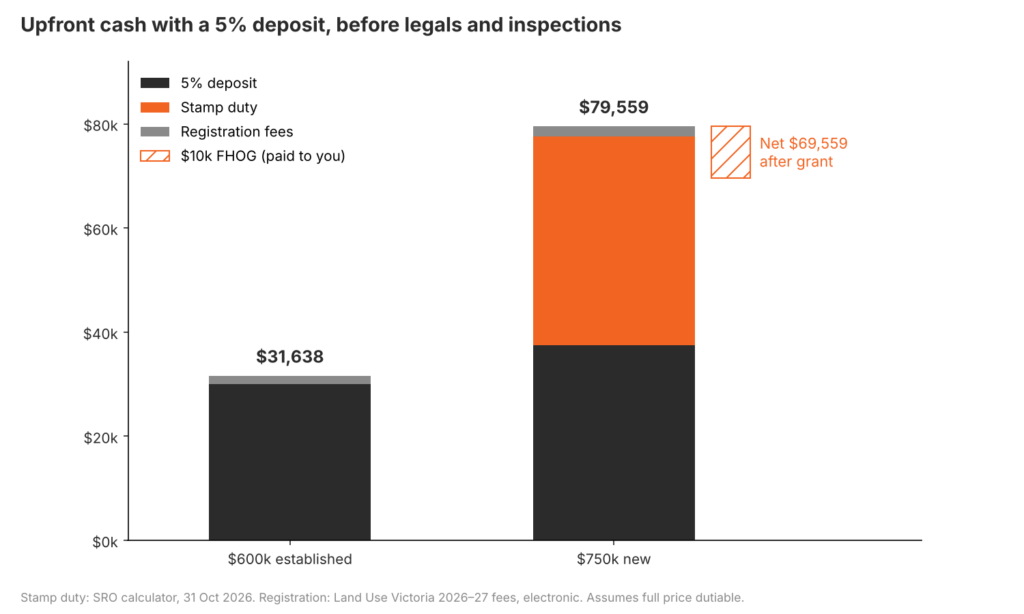
Here’s what two first home buyers using the 5% Deposit Scheme would need in deposit and government costs.
| $600,000 established home | $750,000 new home | |
|---|---|---|
| 5% deposit | $30,000 | $37,500 |
| Stamp duty | $0 | $40,070 |
| Transfer registration fee | $1,509 | $1,860 |
| Mortgage registration fee | $129 | $129 |
| Subtotal | $31,638 | $79,559 |
| First Home Owner Grant | n/a | -$10,000 |
| Net, before legals and inspections | $31,638 | $69,559 |
The difference is about $38,000, and most of it is stamp duty. At $750,000, the $10,000 grant covers only a quarter of the $40,070 in duty. For many buyers, a home up to $600,000 needs far less cash upfront.
Want a checklist to work through? Download the First Home Buyer guide for the checks to make before you start looking.
Which schemes can you stack?
Most first home buyer schemes in Victoria work together. The one exception is that you choose between the 5% Deposit Scheme and Help to Buy.
| Stamp duty relief | FHOG | 5% Deposit Scheme | Help to Buy | FHSS | |
|---|---|---|---|---|---|
| Stamp duty relief | ✓ | ✓ | ✓ | ✓ | |
| FHOG | ✓ | ✓ | ✓ | ✓ | |
| 5% Deposit Scheme | ✓ | ✓ | ✗ | ✓ | |
| Help to Buy | ✓ | ✓ | ✗ | ✓ |
The right combination depends on your price, your income, and whether you buy new or established. For example, a couple earning $170,000 is over the Help to Buy limit but can still use the 5% Deposit Scheme. A single buyer on $95,000 could use either if they meet the other rules, and the better choice depends on whether they’d rather own all of their home or borrow less.
Working through those trade-offs for your situation is what a conversation with a broker is for. And at The Finance Architect, that support doesn’t end at settlement: every client gets an annual loan review, so your loan keeps working as your circumstances change.
Frequently asked questions
How much is the First Home Owner Grant in Victoria in 2026?
$10,000, for a new home valued at up to $750,000. Established homes don’t qualify. The old $20,000 regional grant has ended.
Do first home buyers pay stamp duty in Victoria?
Not on homes valued up to $600,000, if you meet the eligibility rules. Between $600,001 and $750,000 you pay reduced duty, and above $750,000 you pay full duty.
Can I use the 5% Deposit Scheme and Help to Buy together?
No. You can use one or the other. Both can be combined with stamp duty relief and the First Home Owner Grant.
Is the Victorian Homebuyer Fund still open?
No. It closed to new applications on 10 September 2025. Help to Buy is now the shared-equity option available to Victorians.
How much do I need upfront to buy my first home in Melbourne?
At least your deposit (from 2% or 5% with a scheme) plus any stamp duty, registration fees, legals and inspections. On a $600,000 established home with a 5% deposit, the deposit and government costs come to about $31,600. The upfront costs checklist above has the full breakdown.
Your price decides your help
- Up to $600,000: no stamp duty, the lowest upfront cash.
- Up to $750,000: reduced duty above $600,000, and a $10,000 grant for any new home up to this price.
- Up to $950,000 in Melbourne or Geelong: a 5% deposit with no LMI, or 2% through Help to Buy if your income qualifies.
- Budget for registration fees, legals and inspections on top.
If you’d like to know exactly which schemes you qualify for and what you’ll need upfront, book a free 20-minute Discovery Call. We’ll map your options against your price and your income.
This article provides general information only and doesn’t take into account your objectives, financial situation or needs. Scheme rules, caps and fees change; check current details with the State Revenue Office Victoria, Housing Australia or the ATO before acting.