
If the number a bank or an online calculator gave you is lower than the homes you’ve been looking at, you’re not alone. The Reserve Bank has lifted the cash rate five times in 2026 (RBA cash rate table), most recently to 4.85% on 3 November (RBA). That is its highest level since 2008 (ABC News). Canstar estimates that someone on the average full-time wage of $108,650 can now borrow more than $58,000 less than they could in January, and a couple on two average wages almost $117,000 less (ABC News, citing Canstar).
You can’t change the cash rate. You can change most of the other things a lender looks at. This guide explains how lenders work out your number, five steps to increase borrowing power before you apply, and when to take each one. It’s written for first home buyers, with Victorian examples.
The short version
- Your borrowing power is the most a lender will let you borrow. It’s worked out by testing whether you could repay the loan at a rate 3 percentage points above the one you’d actually pay.
- After five rate rises in 2026, that number is lower for everyone.
- The fastest wins are cutting credit card limits, closing buy now pay later accounts and clearing car or personal loans. In our worked example, closing one card and paying out one car loan lifted a Melbourne couple’s borrowing power by about $90,000.
- Lenders differ more than most people expect. The same couple’s figure ranged from $680,000 to $956,000 across about 40 lenders.
- Three months of tidy spending, complete income documents and the right lender make up the rest.
- Government schemes help with your deposit. They don’t change how much you can borrow.
How much can first home buyers borrow? How lenders work out your number
As a rough guide, if you have no other debts and standard living expenses, many lenders will lend around 4 to 6 times your gross household income. Your actual figure comes from a test: a lender takes your income, subtracts your living expenses and existing debts, then checks whether what’s left would cover the repayments at a higher interest rate than you’d really pay.
That higher rate is the part most people haven’t heard of. The banking regulator, APRA, requires banks to assess every new borrower at a rate at least 3 percentage points above the actual loan rate (APRA), and it confirmed in May 2026 that this buffer stays in place (APRA). So if your loan rate is 6.5%, the lender checks that you could manage repayments at 9.5%.
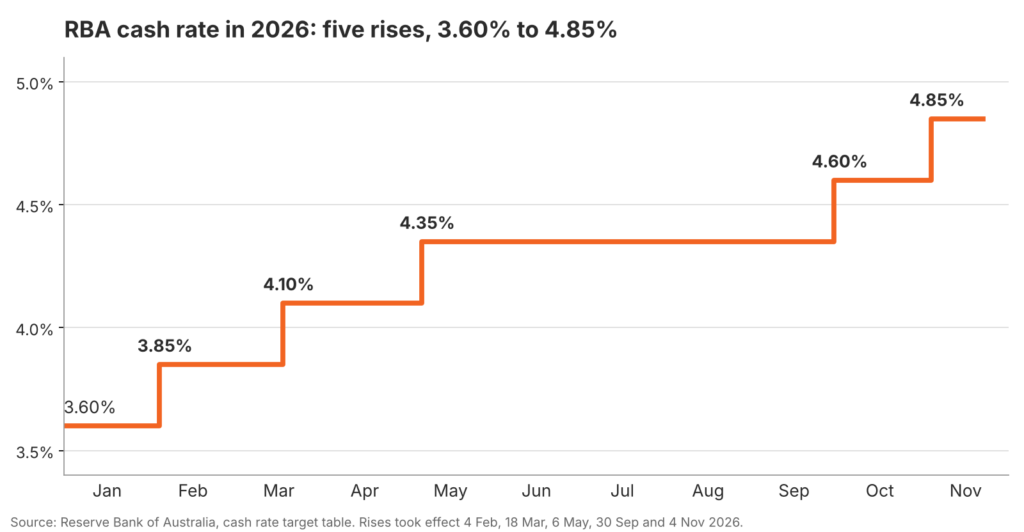
This is why every rate rise cuts borrowing power, even if nothing about you has changed. The test rate moves up with the loan rate, the tested repayment gets bigger, and the loan your income can support gets smaller.
It’s also why two lenders can give the same person different answers. Each applies the same buffer, but they differ on how much of your overtime or bonus they count, how they treat a HELP debt, and what they assume about your expenses and credit cards.
Step 1: Cut your credit card limits and close buy now pay later accounts
Lenders assess your credit card limit, not your balance. A card you pay off every month, or never use, still counts against you.
The lender assumes you could spend up to the limit tomorrow, so it builds a repayment on the full limit into your commitments. Most lenders allow for repayments of 3.8% of the limit each month. On a $10,000 limit, that’s $380 a month treated as already spent, for a card with nothing owing on it. In our worked example below, closing one $10,000 card added about $45,000 to a couple’s borrowing power at a typical lender. Of everything in this guide, dealing with card limits is usually the quickest way to increase borrowing power.
What to do:
- Close any card you don’t need.
- Reduce the limit on the card you keep to the lowest amount you can live with.
- Ask the card provider for written confirmation of the closure or the new limit, and keep it for your application.
- Pay out and close buy now pay later accounts.
Buy now pay later has been regulated as credit under the national credit laws since 10 June 2025 (ASIC). Lenders see these accounts on your statements and treat them as ongoing commitments.
How you’ll know it’s done: you have the closure or limit letters, and your last three months of statements show no buy now pay later payments.
Step 2: Clear the debts that cost you most
A car loan or personal loan repayment comes straight off the income a lender will count. Clearing a small balance before you apply can add more to your borrowing power than the same money would add to your deposit.
Start with car loans and personal loans, because their monthly repayments are high compared with what’s owing. If you’re close to paying one out, it can be worth finishing it. If doing so would take a large bite out of your deposit, get the numbers run both ways before you decide.
HELP debt (HECS) works differently, and the rules changed recently.
- Repayments reduce your assessable income. From 2026-27, you repay nothing on income up to $69,528, then 15 cents for each dollar above that, up to $129,717 (ATO). On a $90,000 income, that works out to about $3,071 a year, or roughly $256 a month.
- Lenders can now leave out a HELP debt that’s nearly finished. APRA’s guidance says it’s reasonable for a bank to exclude HELP repayments where the debt is expected to be repaid within 12 months (APRA). Only some lenders apply this, so check before you assume your HELP debt won’t count.
Paying off a large HELP debt with your deposit savings is rarely the first move. HELP charges no interest, only annual indexation (ATO), and your deposit usually does more work as a deposit. A small remaining balance is a different story.
How you’ll know it’s done: you have payout letters for any loans you’ve closed, and you’ve made the HELP decision with figures in front of you.
Step 3: Tidy up three months of spending
Lenders read your bank statements, and they generally use whichever is higher: the living expenses you declare, or a standard benchmark for a household like yours. The three months before you apply are the ones they look at most closely.
This isn’t about hiding anything. It’s about your statements showing an accurate, sustainable level of spending. Things that lift your assessed expenses or raise questions include:
- subscriptions and memberships you’ve forgotten about
- frequent food delivery and discretionary spending well above your declared budget
- gambling transactions
- accounts that regularly go into overdraft
- regular payments you haven’t mentioned, such as money to family or an informal loan.
Write a budget, then live to it for three months so the statements and the application match.
How you’ll know it’s done: three months of statements that line up with the expenses you’ll declare.
Step 4: Make sure all your income is counted
Lenders treat base salary, overtime, bonuses, commission, casual work and second jobs differently. Some count most of your extra income. Others count only part of it, or want a longer history first.
If a meaningful share of your pay comes from overtime, shift penalties, bonuses or a second job, the lender you choose matters, and so does your paperwork. Gather your recent payslips, your latest income statement from myGov, and an employment letter or contract if your pay structure is unusual.
Two more things affect how income is read:
- Job changes. A new job often means a probation period, and some lenders won’t proceed until it’s finished. If you’re planning a move, time it for after settlement where you can.
- Buying with someone else. Two incomes usually support a larger loan than one. Both of you are then responsible for the whole debt, so it’s a decision to make with care.
How you’ll know it’s done: your income documents are together, and any job change is planned around your purchase.
Step 5: Choose the lender and loan set-up that fit you
The same buyer can get a noticeably different result from different lenders, because each has its own policy on income, expenses, HELP debt and credit cards.
Your bank will assess you against its own rules only. A broker can run your details through several lenders’ calculators and show you where your situation fits best. We work with more than 50 lenders, and for first home buyers the gap between them is often the difference that matters. In our worked example below, the same couple’s borrowing power ranged from $680,000 to $956,000 depending on the lender. If you’re weighing this up, we’ve written about using a mortgage broker instead of going to your bank.
Loan set-up plays a part too. A 30-year term has lower repayments than a 25-year term, so it supports a larger loan. In our example, moving to 25 years cut the highest lender’s figure from $1.01 million to $952,000. You can still pay it off faster once you’re in.
You may have read that the regulator now limits high debt-to-income lending. Since 1 February 2026, banks can write only 20% of their new home loans at six times income or more, according to the same APRA submission cited earlier. In practice, few owner-occupiers get near it. Only 3.7% of new owner-occupier loans were at that level in the June quarter of 2026 (APRA). For most first home buyers the 3-point buffer is the limit that bites, not this cap.
How you’ll know it’s done: you’ve seen your borrowing power calculated at more than one lender, on the loan term you intend to take.
Worked example: one Melbourne couple, four changes
Closing one credit card and paying out one car loan lifted this couple’s borrowing power by about $90,000 at a typical lender. Their choice of lender made an even bigger difference.
We ran a sample first home buyer couple through the borrowing calculators of about 40 lenders on our panel on 17 November 2026, using each lender’s current variable rate for owner-occupiers. The couple is an example we made up, not a real client:
- Melbourne, renting, no dependants
- Incomes of $95,000 and $85,000 a year, both PAYG
- One credit card with a $10,000 limit, paid off in full each month
- A car loan costing $450 a month
- A $25,000 HELP debt
- Each lender’s standard allowance for living expenses
- An 80% loan-to-value ratio, principal and interest, over 30 years
| Scenario | Where most mainstream lenders sit | Lowest to highest lender |
|---|---|---|
| Starting point | $740,000 to $765,000 | $680,000 to $956,000 |
| Credit card closed | $785,000 to $810,000 | $726,000 to $1.01 million |
| Car loan paid out | $780,000 to $800,000 | $735,000 to $1.01 million |
| Card closed and car loan paid out | $840,000 to $850,000 | $780,000 to $1.01 million |
What the numbers show:
- Closing the card added about $45,000 at a typical lender, for a card with nothing owing on it.
- Paying out the car loan added $35,000 to $40,000. That one needs cash to clear the balance, so weigh it against your deposit.
- Doing both added about $85,000 to $100,000. At a typical lender, that’s around 4.7 times the couple’s combined income.
- The lender mattered most. Before changing anything, the same couple’s figure ranged from $680,000 to $956,000 depending on the lender: a gap of $276,000.
- A shorter term costs you. With the card closed and car loan paid out, a 25-year term brought the range down to $750,000 to $952,000, from $780,000 to $1.01 million over 30 years.
The HELP debt stayed in every scenario. These are calculator estimates on one date, not loan approvals, and your own figure depends on your details.
Borrowing power is not the same as buying power
What you can spend on a home is your borrowing power plus your deposit, minus your buying costs. Government schemes help with the deposit. They don’t increase what a lender will lend you.
The two are often blurred together, so it’s worth being clear. The Australian Government 5% Deposit Scheme lets eligible first home buyers purchase with a 5% deposit and no lenders mortgage insurance (LMI), because Housing Australia guarantees part of the loan (Australian Government). Since 1 October 2025 it has had no income caps and no waitlists. The property price cap is $950,000 in Melbourne and $650,000 in regional Victorian centres such as Bendigo (official price cap tool, checked 15 November 2026). Caps are set by postcode, so check yours with the tool on the scheme’s website.
That can bring your purchase forward by years. It doesn’t change the lender’s test. A smaller deposit means a bigger loan, and you still have to pass the same assessment on that bigger loan. Outside the scheme, LMI generally applies when you borrow more than 80% of the property’s value.
If you’re still working on the deposit side, start with how much deposit you need for your first home.
Mistakes that shrink your borrowing power
Most of the damage is done in the weeks before applying, and most of it is avoidable.
- Taking on new credit. Car finance, a new credit card or a buy now pay later purchase just before or during your application adds a commitment and a credit enquiry.
- Changing jobs mid-process. Even a better-paid job can stall an application if it comes with probation.
- Applying to several lenders at once. Each application leaves an enquiry on your credit file. A run of them in a short period can look like you’ve been knocked back.
- Borrowing the maximum because you can. The lender’s figure is a ceiling. Work out the repayment you’d be comfortable with at today’s rates, with room for the things you don’t want to give up, and work back from there.
When to do what
| When | What to do |
|---|---|
| Three months before you apply | Close or reduce credit cards. Close buy now pay later accounts. Start living to your budget. Decide which debts to clear. |
| One month before | Gather income documents. Have your borrowing power calculated across lenders. Check your eligibility for the 5% Deposit Scheme. |
| From application to settlement | No new credit. No job changes if you can avoid them. Keep your spending steady. |
Frequently asked questions
Why is my borrowing power low?
The three most common reasons are the interest rate test, credit limits and expenses. Lenders test you at a rate 3 percentage points above the real one, and five rate rises in 2026 have pushed that test rate up. Unused credit card limits are counted as if they were debts. And your statements may show higher spending than you realise.
Does a credit card limit affect borrowing power if I never use it?
Yes. Lenders assess the limit, not the balance, because you could draw on it at any time. Reducing the limit or closing the card before you apply removes that commitment from the calculation.
Does HECS or HELP debt reduce how much I can borrow?
Yes, because the compulsory repayments reduce the income a lender counts. Since 2025, APRA’s guidance has allowed lenders to leave out a HELP debt that will be repaid within about 12 months, and some lenders do.
How much has borrowing power dropped in 2026?
Canstar estimates a fall of about 11% over the year for a borrower on the average full-time wage, which is more than $58,000. That estimate assumes 90% of after-tax income is available for repayments and expenses, and a 3-point buffer. Your own figure depends on your income, debts and lender.
Does Afterpay affect a home loan application?
It can. Buy now pay later has been regulated as credit since June 2025, the payments show on your bank statements, and lenders treat active accounts as ongoing commitments. Closing them before you apply is the safest approach.
Do all lenders give you the same borrowing power?
No. All banks apply the same minimum buffer, but each has its own policy on income types, living expenses, HELP debt and credit cards, so the same buyer can get different results. In our worked example, one couple’s figure ranged from $680,000 to $956,000 across about 40 lenders.
How to increase borrowing power: where to start
Lenders test you at 3 points above your real rate, and that test has become harder to pass this year. The parts you control are your credit limits, your other debts, three months of spending, your income documents and your choice of lender. If you want to increase borrowing power, start three months before you plan to apply, and remember that schemes help your deposit, not your borrowing power.
If you’d like your borrowing power worked out properly, across lenders, book a Discovery Call. It’s free, takes 20 minutes on Zoom, and there’s no pressure and no obligation.
Not ready to talk yet? Download our First Home Buyer checklist, “6 checks before you start looking at homes”, from the First Home Buyers page.
Sources
- Reserve Bank of Australia, monetary policy decision, 3 November 2026: rba.gov.au
- Reserve Bank of Australia, cash rate target table: rba.gov.au
- ABC News, 3 November 2026, on the cash rate reaching its highest level since 2008: abc.net.au
- Canstar borrowing capacity analysis, 2026: Canstar and ABC News
- APRA, macroprudential policy settings, 28 May 2026: apra.gov.au
- APRA, submission on housing lending, April 2026: apra.gov.au
- APRA, quarterly ADI property exposure statistics, June 2026 highlights: apra.gov.au
- APRA, treatment of HELP debt obligations: apra.gov.au
- ATO, study and training loan repayment thresholds and rates, 2026-27: ato.gov.au
- ASIC, media release 25-069MR on buy now pay later reforms, 8 May 2025: asic.gov.au
- Australian Government 5% Deposit Scheme: firsthomebuyers.gov.au
- ATO, study loan accounts (interest and indexation): ato.gov.au
This article is general information only and doesn’t take into account your objectives, financial situation or needs. Lending criteria, rates and scheme rules change, and all applications are subject to lender approval. Figures are current as at 24 November 2026.
Dale Wilkinson is a Credit Representative (No. 450039) of Buyers Choice Licencing Pty Ltd ACN 626172281, Australian Credit Licence No. 509484. The Finance Architect is a registered business name of The Trustee for The Wilkinson Discretionary Trust ABN 16168596553.